

Why look at NASEM on indoor vaping?
The National Academies of Sciences, Engineering and Medicine (NASEM) is an important source. It is a congressionally chartered organization that serves as the collective scientific national academy of the United States of America (source).
The studies and reports by the Academies of Science that form NASEM:
serve as public policy advisors, research institutes, think tanks, and public administration consultants on issues of public importance or on request by the government .
NASEM is the brand name behind 200 annual publications the National Academies Press.
The reports produced by the National Academies have been characterized as reflective of scientific consensus.
One of these reports is entitled “Health Risks of Indoor Exposure to Fine Particulate Matter and Practical Mitigation Solutions.” It was published in 2024. can be downloaded here:
https://doi.org/10.17226/27341 .
The report is concerned with sources of indoor particulate matter, their health effects and mitigating strategies. It dedicates in its Chapter 3 a short subsection to environmental emissions from vaping in pages 43-44. This subsection contains a summary review based on selective references to articles reporting concerning risks from environmental exposure to vaping aerosol.
Most of the cited articles in this brief review follow the patterns of anti-vaping science applied to “passive” vaping: misrepresentation of “particles”, unwarranted speculations, laboratory studies without environmental relevance, or are based on observational studies whose questionnaires ignore determinant confounding factors.
Chapter 3 of the report: “Sources and Composition of Indoor Particulate Matter” offers a review of recent scientific literature on the sources of indoor particulate matter (PM), ultrafine particles (UFP diameters < 100 nm) and PM2.5 (diameters < 2.5 µm). PM sources are classified in 5 formation mechanisms: combustion processes, other non-combustion heating processes, mechanical particle re-suspension, residual particles from liquid aerosol evaporation, and secondary particles formed through chemical reactions. PM sources are also classified in terms of particle size, exposure time (intermittent or continuous), emission rates, chemical complexity and specific health effects.
Fatal error from the onset of the report.
Table 3-1 already displays a fatal error in the report on how the authors classify environmental emissions from vaping and smoking
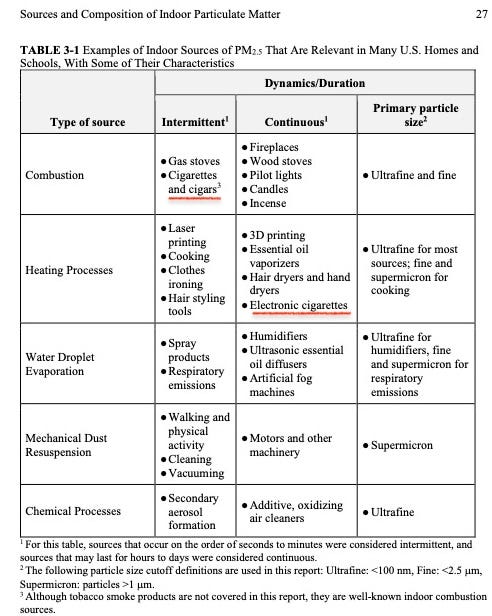
The Table classification for environmental vaping and smoking emissions is
Vaping as “continuous” (pollution sources that might last for hours to days)
Smoking as “intermittent” (pollution sources that occur on the order of seconds to minutes))
It is a scandal that such an extremely blind and ignorant assessment appears in a NASEM report. This report just managed to turn scientific evidence upside down: the continuous side-stream (SS) emission from the cigarette tip implies, without doubt and with full evidence, a continuous exposure lasting hours (and even days and months if we assume “third hand smoke”). As a contrast, all what vaping releases to the environment is the users’ exhalation, with plenty of evidence that under normal conditions (not vape fests or vape shops) the exhaled aerosol evaporates in fast time frames ( < 20 s, see Post 8).
Table 3-1 already notifies the readership that “Although tobacco smoke products are not covered covered in this report, they are well known indoor combustion sources”. This announcement adds fuel to the scandal, since tobacco smoke is not only just “another combustion source”, it is in indoor smoking environments one of the most intense sources of PM.
Not covering tobacco smoke as a main source of PM indoor pollution and downplaying its exposure as “intermittent” lasting seconds, is really a low standard for the prestigious NASEM. Adding insult to injury, this attitude comes with grossly misrepresenting exposure to vaping, the harm reduction option to smoking.
Since the NASEM embodies the jewel of the crown in the scientific evaluation by the US establishment, this attitude reveals to what degree the “powers that be” in the US have been overturning evidence by considering that in indoor spaces vaping is more hazardous than smoking.
“Third hand vaping” rises again.
In trying to find which reasoning the authors of the NASEM report might have followed to regard environmental exposure to vaping as continuous, I read their first sentence of their review
“Although e-cigarettes do not involve combustion, they release aerosols that can remain in the air and on surfaces of indoor environments for extended periods after use.”
This was a strong claim without arguments or references to support it. I kept reading and noticed that the review of chapter 3 (pages 43-44) cites two studies in vape shops (LI et al 2020 and Son et al 2020) that I reviewed in a previous post. Vape shops in these studies were indoor spaces with intense vaping activity, hence the evaporation of the accumulated aerosol droplets slows down and the gas phase contains large concentrations of PG.
However, this aerosol accumulation that keeps residual aerosol levels for long periods does not involve chemical reactions, so there is no aging, just more of the same chemical composition of the aerosol for longer times. I also provided experimental evidence showing that short term exposure to PG is not harmful, even in large concentrations. Nevertheless, long time permanence in the environment only occurs in sporadic events vape shops or vape conventions, not in the environments where vapers normally vape.
Further reading I found a paragraph that alludes to “third hand vaping” analogous to THS, mentioned as a fact. It seems that this might have been the main argument justifying the authors’ description of vaping as a continuous exposure.
I have already dedicated two extensive Substacks (here and here) to show that a “third hand vaping” exposure parallel to THS contradicts available evidence: it does not exist in the environments and conditions in which millions e-cigarette users vape.
Available evidence shows that the only feature common to THS that might occur in vaping, nicotine adsorption, only occurs under special and unrepresentative conditions (contrived aerosols in the lab and spaces with abnormal vaping intensity).
Lat’s see the paragraph in the review of chapter 3:
“In addition, e-cigarette aerosols can leave residue on indoor surfaces and particles, which can accumulate over time and potentially affect indoor air quality, commonly referred to as thirdhand exposure (Acuff et al., 2016; Goniewicz and Lee, 2015). Colby et al. (2023) found that residual emissions from an electronic cigarette partitioned from surfaces onto other airborne particles in a manner similar to compounds from conventional cigarettes (DeCarlo et al., 2018).”
The text makes reference to Goniewicz and Lee 2015, a laboratory experiment that I reviewed in my previous Substack, in which a lot of aerosol is injected during 1.5 hours into a chamber with samples inside. The text mentions three references that I did not mention in my previous Substacks. Two of them: Acuff et al 2016 and DeCarlo et al 2018 deal exclusively with THS (tobacco smoke, not vape aerosol), therefore we can rule them out. The other cited reference is Colby et al 2013, another laboratory experiment even more unrealistic than Goniewicz and Lee. It is worth looking at it.
Colby et al 2023 showed that to get new “particles” re-emitted (“revolatized”) from specially prepared “residues” of vaping aerosols (from a Juul) requires 5 days of intricate chemical procedures, diligently applied to an aerosol contained in a small closed chamber. This is a summary of their protocol:
“The JUUL experiments began on day 0 with 4 puffs ( 60 mL each, 3–4 s draw time) of mango flavored vape introduced into a cylindrical stainless-steel chamber (37.1 L, 36 cm 36 cm) via a sterile 60 mL syringe.”
The aerosol was then mixed and then flushed with air to keep only the residues left undisturbed until the next day when the chamber was sampled and analyzed. After filtering laboratory air, laboratory generated ammonium sulfate (AS) seed aerosol was introduced into the chamber. This experimental procedure was performed 1, 2, and 5 days after vape introduction to the chamber. The aerosol was finally sampled.
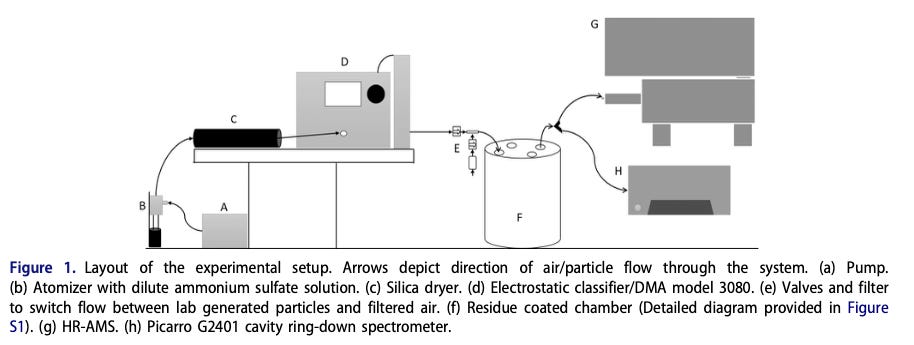
This study shows how much the aerosol has to be chemically coerced to obtain a “third hand” product (a new artificial aerosol from re-emitted particles). I have no criticism of the chemical procedures (see the paper). This study is technically interesting because contrary to previous studies it did not rely on nicotine adsorption, since Juul aerosol contains protonated (salt based) nicotine that is not volatile and (most likely) does not adsorbs.
However, it is evident that the results of this study are irrelevant to assess the risk profile of environmental vape emissions. A syringe generated aerosol emitted in 4 puffs from a Juul aerosol would evaporate in 10-20 seconds if released into a natural air environment (not injection into a chamber). This has been measured experimentally also in terms of aerosol generated by a syringe by Lampos et al (2019) with a device operating at 6 W (similar to a Juul). It would be impossible to conduct the experiment of Colby et al outside their laboratory.
While Colby et al recognize that their experiment is very idealized, they still mention the “potential” for transport of residues to the environment (a “third hand” effect) and comment on studies that I reviewed in the previous Substack post (Son et al and Khachatoorian et al) that report artificially enhanced nicotine adsorption. However, with the current preference for nicotine salts, we can really say fare well to all “third hand” attempts on vaping.
I believe that the arguments and evidences presented above COMPLETELY DEMOLISHES the claim in this NASEM report that indoor exposure to vaping aerosol is “continuous”. Now, let’s see the remaining of their arguments.
A collection of boilerplate arguments
The rest of the paragraphs of the summary is made of boilerplate arguments that we know very well, including outdated information, half truths, speculation, exaggeration. I review some of the worse paragraphs
“Protano et al. (2018) showed that, over time, e-cigarette products have employed progressively lower electrical resistance and higher power conditions, leading to increasing PM2.5 emissions.”
This comment is outdated, the vaping market is not evolving to lower coil resistances, but to higher ones (pods and disposables). Protano et al (2018) is part of a series of vaping hostile studies by Italian public health institutions. They only count and measure “particles”. Although they recognize that the “particles” rapidly evaporate (their graphics show it), they still present them as hazardous, in some studies using a crude lung deposition model to voice alarm on their inhalation.
“Several studies and literature reviews have reported particle emissions to consist mostly of ultrafine and submicron particles (L. Li et al., 2020; Protano et al., 2018; Saffari et al., 2014; Volesky et al., 2018; T. Zhao et al.,2016).”
Unwarranted panic on the “particles”. Obviously, inhalation of vaping droplets 98-99% made of PG, VG, nicotine and water should represent a risk, but comparable to inhaling droplets from other household aerosols or low air pollution, not remotely comparable to inhaling particles (droplets and solid) from tobacco smoke or heavy air pollution.
“While e-cigarettes may be considered by users a less harmful alternative to traditional cigarettes, the health effects of inhaling e-cigarette particles are not yet fully understood, and their use is not risk-free.”
To only mention “users” as those considering vapes less harmful alternative looks innocent, but it is a veiled form to convey the notion that since users are not “experts”, this claim is questionable. This boilerplate phrase omits the fact that users agree with solid evidence of significantly less harmful than cigarettes, also recognized by researchers and institutions (the UK, NZ, Sweden). Then, the phrase indulges in a straw man argument: refutes the claim that vaping is “risk free”, when nobody makes this claim. A widely used pseudo-argument to avoid recognizing a spectrum of risks.
“E-cigarette use has been associated with a variety of respiratory and cardiovascular effects, particularly in children and adolescents (Islam et al., 2022; M. P. Wang et al., 2016). Specifically, secondhand nicotine vaping has been associated with bronchitic symptoms and shortness of breath in young adults (Islam et al., 2022)”
Resounding big claims based on weak evidence.
Islam et al (2022) has numerous limitations. The authors examine associations between passive vaping and respiratory symptoms (bronquitis, wheezing, shortness of breath), based on the prospective Southern California Children Health Study Carolina School of Medicine cohort from 2014 to 2019 (mean age 17). This is their criteria to define passive vaping
Second-hand nicotine vape exposure at each wave was defined based on participants’ reports that anyone in the household (other than the participant) used ‘e- cigarette or other electronic nicotine delivery devices’.
Mixed effect logistic regression models were used to evaluate the association between secondhand nicotine vape exposure in each wave and each respiratory symptom
The questionnaire included active and passive smoking and active vaping. The authors claim to adjust for active/passive smoking and all sorts of demographics. The limitations of the study are barely mentioned or discussed.
This study is of one of the types that find associations and (implicitly) hint causation. However, there are many counfounders (alternative variables that can influence causality) that are not even considered (even in a discussion), since the subjects are exposed to many pollutants besides vapes that can also cause the symptoms, which could have been caused years before the surveys.
Although the study has a longitudinal design: shows that symptoms increase in the years after first sampling, it shares the inherent weakness of self reported information on exposure (how much vaping/smoking took place in their homes?), on symptoms and on other factors, or that symptoms denote precondition or propensity.
Wang et al, 2016 is a similar but cross sectional smaller (and much older 2012-2013) study in Hong Kong. It is even a weaker evidence on effects of passive vaping than Islam et al.
“Hypersensitivity pneumonitis has been reported as arising from firsthand and, in rare cases, secondhand exposure to e-cigarette emissions (Galiatsatos et al., 2020). These and other health effects may become important, particularly for people with underlying respiratory conditions.”
Again, big resounding claims on important hazards based on very weak evidence. Galiatsatos et al 2020 provides a single case report, very likely an EVALI patient (the patient became ill during EVALI and paper was published just after the outbreak). There are several case reports in the literature that are given wide diffusion, but it is often difficult to determine if vaping was the cause and they are too few (compared with millions of users) to make a serious epidemic case for for people with underlying respiratory conditions.
The 2018 NASEM report.
Despite its limitations the 2018 report “Public Health Consequences of E-Cigarettes” represented an effort of openness by the medical, scientific and regulatory establishment of the US. Sadly, in 2026 this openness is gone, replaced by a very narrow minded and obstinate crusade against nicotine to protect youth. But in 2018 the NASEM report openly (and bravely) manifested that:
Conclusion 5-3. There is substantial evidence that except for nicotine, under typical conditions of use, exposure to potentially toxic substances from e-cigarettes is significantly lower compared with combustible tobacco cigarettes.
However, on the nature of the “particles” and environmental vaping aerosol the report presented contradictory views. The following statement (page 72) is a very accurate and enlightened description of the aerosol particles:
“While the particle count in e-cigarette aerosols may not be substantially different than mainstream combustible tobacco smoke, the nature of the particles is substantially different. E-cigarette aerosol particulates consist largely of aqueous droplets and vapors of humectants, either PG or glycerol, whereas particulates in combustible tobacco smoke are com plex, largely organic constituents that contain polycyclic aromatic hydro carbons and a variety of other known or suspected carcinogens. Thus, it would be incorrect to assume that the long-term health risks of the two aerosols were similar just because particle count was similar.”
I find it truly amazing (and deeply frustrating) that given this accurate concluding statement in this report, that after 2018 and all the years up the present in 2026 we still read in the scientific literature on vaping fallacious scare stories about the “particles”. Of course, I know that Prof Glantz was scare mongering about “particles” already in 2013, but those elaborating this NASEM report, either were not aware of Prof Glantz, or did not consider him to be a trustworthy source on the physics of vaping aerosols.
As a physicist, it is obvious to me that in an aerosol generated by heating a liquid below ignition its particulates MUST BE droplets, with similar chemical composition as the liquid. For me this is like saying gravity makes the apple fall on Newton’s head.
However, despite this clarification on the particles in the NASEM report, the chapter on “second hand” aerosol (pages 78-83) reviewed uncritically a mixed bag literature published before 2018, consisting of good studies and some flawed ones that spread nonsensical panic on particles (identified with the inappropriate term of “particulate matter” PM). The report reviewed studies on vape conventions described as massive ejections of PM.
All this stands in contradiction with the paragraph I quoted in page 72, which referred to droplets of the inhaled aerosol. However, the inhaled aerosol does not experience heat degradation reactions that produce toxins in the respiratory tracts, only physical processes that do not change the chemistry of the droplets. The exhaled aerosol is even less toxic than the inhaled one because close to 100% of the aldehydes are retained.
How can it be that pages 78-83 are in such blatant contradiction with page 72? Likely because these parts were reviewed by different researchers. Another drawback of the 2018 was its uncritical endorsement of the “gateway to smoking” promoted by very influencial tobacco control researchers. This is (in my opinion) a defect of NASEM reports: they are written collectively, so we do not know who wrote different parts or sections. Hopefully a future NASEM report will recover the openness of the 2018 report.