
Objectives of Parts I, II and III
A recent literature has emerged using animal models to simulate the physiological impact from exposure of human children to “thirdhand e-cigarette aerosol”, which authors denote by “THEA” or similar acronyms. I will use the term “THEA” for third hand phenomena in vaping.
These animal models exhibit serious shortcomings. The purpose of this post (Part I) and the follow up posts (Part II) and (Part III) is to address these shortcomings along the following plan:
Part I: There is no evidence (experimental and observational) of measurable THEA in environments with children occupancy (homes where adult occupants vape, nurseries, schools). This fact follows from the vast differences between environmental aerosols from smoking and vaping.
Part II: A search of the literature found 8 animal models simulating children’s exposure to THEA. I provide a review of these studies. I also examine the risk from dermal exposure.
Part III: If there is no evidence of measurable THEA in normal human environments, then why animal models detect and measure THEA? The answer lies in the specific characteristics of the animal model environment.
Color code in this post: RED = “third hand” & BLUE = “second hand”
“Third hand” vaping in animal models
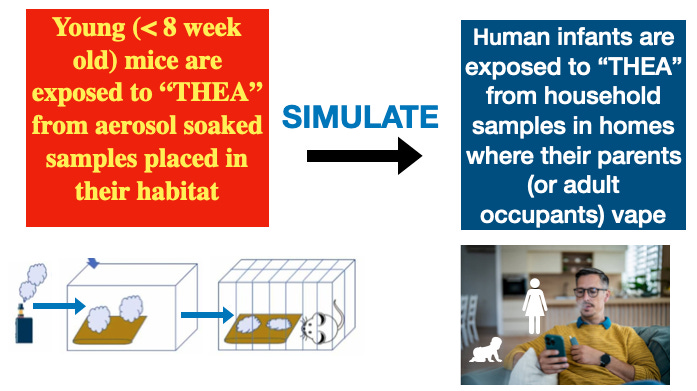
Common characteristics in animal models simulating children exposure to THEA.
They all assume that “THEA” is a generic feature of aging Environmental Vaping Aerosol (EVA, the “secondhand”), just as Third Hand Smoke (THS) is a generic feature of aging Environmental Tobacco Smoke (ETS, the “secondhand”).
They all follow the same standardized protocol:
textile fabric samples inside small inhalation chambers are exposed to substantial aerosol mass
the aerosol soaked samples are subsequently transferred to cages inhabited by young or neonate mice.
Some of the mice are placed in the cages together with aerosol soaked samples for long periods (typically 2 hours/day 5 days/week for 6 weeks).
Some of the mice are placed in cages with clean unexposed samples to serve as controls.
The purpose of these animal models is:
All studies
consistently report significant biological effects in young and neonate mice exposed to the aerosol soaked samples.
executed rigorous and (apparently) impeccable biological protocols, with authors hinting or suggesting (some more emphatically than others) that the detected effects “might” “could” translate to human children
However, there are problems in this animal model paradise:
There is no “Translational Relevance” of the exposure of mice to “THEA” in animal models.
What is “Translational Relevance”? An exposure in an animal model is “translationally relevant” if it reasonably represents the same observed and verified human exposure,
Ideally, “Translational Relevance” should represent, not only same exposure in human environments (exposure to agent of same composition), but also same exposure route, dose, duration, all despite species differences.
In practice, ideal Translational Relevance is seldom met, but the minimal requirement is observed measurable human exposure to same agent. Also, even under ideal conditions Translational Relevance does not imply similar or comparable biological responses in exposed animals and humans
In other words: mice studies on THEA do not comply with the minimal requirement of Translational Evidence, as they are simulating an effect (children exposure to THEA) that has not been observed at measurable levels in human environments with children occupancy
As a contrast, the minimally necessary requirement of “Translational Relevance” is satisfied by animal models of Third Hand Smoke (THS) exposure, as there is experimental and observational evidence of its measurable presence in human environments with children occupancy.
Research on THEA
The fact that animal models on THEA lack Translational Relavance can be sustained by the lack of experimental and observational evidence of measurable THEA in human environments with children occupancy. This conclusion emerges as a result of my own research that extensively revised third hand effects in smoking and vaping. This research culminated in an extensive review that was recently published in a peer reviewed journal:

This publication synthesized various aspects of third hand smoking and vaping that I examined in previous posts
Is there “third hand vaping”? Part 1: Third Hand Smoke
Is there “third hand vaping”? Part 2: The case for/against Third Hand Vaping
”Third Hand Vaping” in animal models: A summary of a useless research
Also, the following Pub Peer comments on animal models have useful information, including a summary of the full topic:
https://www.pubpeer.com/publications/B604AE5B635D7A1A0E0A6571FDEF16
https://www.pubpeer.com/publications/2ED0097D6126B6FC7FE5392773ED9B
https://www.pubpeer.com/publications/52C0C57CEDFA74913090297194D80D
https://www.pubpeer.com/publications/F8ED5EED3A21D1F97754F063F56535
In what follows I summarize the arguments and evidences that sustain the lack of Translational Relevance of animal studies on THEA.
“Third hand” phenomena in smoking and vaping (nicotine)
As the “second hand” ETS spreads indoors, its gas phase nicotine and hundreds of other volatile and semi-volatile organic compounds (VOCs and SVOCs) deposit and adsorb (attach) on surfaces and walls, forming residues as thin film layers (“sinks”).
THS is formed through the long term evolution (“aging”) of these residues, involving a complex phenomenology: residues becoming airborne (“desorb”), react with indoor pollutants, forming new byproducts and possibly a secondary aerosol.
Although experimentally verified THS phenomenology involves hundreds of compounds engaged in adsorption, desorption and oxidation reactions, its main tracer in field studies is the presence of persistent sinks from adsorption of nicotine, the most abundant SVOC in ETS and very efficient to adsorb in all sort of indoor surfaces (assuming it is free base, which is mostly true in ETS).
Empirically, the presence of THS in human occupied indoor spaces is evaluated through standardized measurements of surface density swipes of adsorbed nicotine and its byproducts (including tobacco specific nitrosamines TSNAs).
Since nicotine is also an abundant SVOC in environmental vaping aerosol (EVA), its role as the main marker of THS makes it tempting to assume that residues of EVA might age to form THEA in analogy with residues of ETS aging to form THS. After all, nicotine in EVA can also adsorb in indoor surfaces, and thus its surface density swipes can provide an empiric comparison of its third hand effects with those of smoking.
However, considering THS as a model for THEA is theoretically questionable, since the two environmental aerosols (EVA and ETS) have very distinct physicochemical properties and thus will hardly follow similar environmental evolution in indoor spaces. Their different properties determine their long term evolution:
ETS: Complex chemistry (thousands of detected compounds) with large non-volatile content of its particulates and substantial number of gas phase reactive compounds (including VOCs, SVOCs and non-volatile). This, plus oxidation reactions with environmental pollutants sustains its long long time airborne permanence that favors long term third hand phenomena like adsorption, desorption and further reactions.
EVA: Much simplified chemistry (< 150 detected compounds) with largely volatile content. Nicotine is its only abundant reactive SVOC compound, (propylene glycol and glycerol are not reactive at the conditions of exhalation). Particulates are liquid droplets with close to same composition as the gas phase. Short time (< 1-2 min) permanence in the environment under normal environmental conditions due to rapid evaporation of droplets into a rapidly dispersing gas phase.
Their distinct properties imply a rich THS phenomenology in smoking, while in vaping the only third hand phenomenon THEA is the formation of indoor sinks from nicotine adsorption.
These differences also influence the scope of this common third hand effect. Although both smokers and vapers retain close to 80-90% of the inhaled nicotine, the exhaled nicotine is different: ETS releases to the environment a substantially larger nicotine mass than EVA
ETS: most released nicotine mass originates from the continuous side stream emission from the tip of the cigarette
EVA: there is no side stream emission in vaping, so EVA releases to the environment a significantly lower nicotine mass only released through the mainstream emission (vaper’s exhalation).
As a consequence, the properties summarized above imply that
ETS strongly favors an aging process leading to a full THS phenomenology in practically all indoor human inhabited environments.
EVA makes the aging process much more difficult and restricted. This does not mean it cannot generate measurable THEA, it means that EVA can only do it under very special conditions and in environments that inhibit its evaporation.
Evidences of THEA
After a comprehensive search of the literature I found evidence of measurable THEA in three experiments and three observational studies:
Three laboratory experiments
Goniewicz and Lee, 2015. Five textile samples in a 30 m3 closed chamber were exposed to aerosol: 100 puffs delivered in 1.5 h for each sample. Largest average measured surface density 205 µg/m2 was found in the tiled floor, remaining samples below 50 µg/m2
Marcham et al, 2019 . Two materials (glass and terrycloth) each placed in 42 Petri dishes of 58 cm2 (42 sinks) inside a 1 m3 chamber. Aerosol was delivered by syringe in 49 puffs in 15 minutes. Average surface density at each sink was 0.75 µg/cm2 (terrycloth) and 0.125 µg/cm2 (glass). Densities decayed very slowly returning to background levels after 4 days (glass) and 16 days (terrycloth).
Colby et al [11], 2023. Aerosol from a Juul was injected into a 37 L stainless-steel cylindrical chamber. It was flushed, leaving its remaining residuals left to interact with a laboratory-generated ammonium sulfate (AS) aerosol. Re-emitted residues were collected after repeating the experiment for 5 days.
These experiments have actually detected the single THEA effect compatible with vaping (nicotine adsorption) produced by vaping aerosol, though they were not produced by the “second hand” EVA, but by syringe injected primary aerosol. Evidently, these THEA measurements were obtained under environmental conditions that bear no connection to normal conditions in which vaping takes place in real life.
Three observational studies inside vape shops operating 8-10 years ago
The studies measured surface swipes of nicotine and its byproducts (including TSNAs).
Khachatoorian et al (2019) First paper and Second paper. Surface densities of wipes were measured only on polyester samples and terrycloth towels externally brought by the researchers. These were placed on and hung in surfaces of the vape shop and in the living room of a vaper. Polyester samples had negligible densities. Swipe densities were significant on terrycloth towels, reaching 1.18 mg/m2 after 6 months in the living room of a user and an enormous value of 108 mg/m2 in one month on a terrycloth towel on the display case of the vape shop (with 80 ng/g NNA). Much lesser densities were measured in samples on other surfaces.
Son et al (2020). Surface density swipes were measured on implanted samples brought by the researchers and also in natural surfaces. Maximal surface densities were measured on implanted samples: cellulose paper: 2.073 mg/m2 (nicotine), 474 ng/m2 (NNA), 184 ng/m2 (NNK). Maximal densities in the natural surfaces were much smaller: 223.6 µg/m2 (nicotine), 4.78 ng/m2 (NNA), 44.8 ng/m2 (NNK).
Important remark on THEA measured in these studies. All surface density swipes in Khachatoorian et al (the second paper) were measured on samples brought externally. This represents an artificial scenario that does not reflect the adsorbed nicotine that would result in these vape shops under normal conditions (without the researchers intervention).
The same remark applies to externally brought samples by Son et al. Evidently, owners and patrons of vape shops would not let a terrycloth towel standing 2 weeks or 1 month on the display case of a vape shop, vapers would not normally leave unattended a towel on a desk in the living room for 6 months.
Placing highly adsorptive external samples for extended time periods is an artifact to enhance nicotine swipes. The only realistic THEA measurements (without this artifact) are the nicotine densities (up to 200 µg/m2) measured by Son et al on natural inherent surfaces of the vape shops.
Vape shops are not children inhabited environments
It is important to put these vape shop measurements under an appropriate environmental and historical context. The 3 studies detecting THEA were published in 2029-2020, but are based on field work conducted between 2015 and 2018.
In the sampled vape shops 10 years ago vaping was allowed, so many vapers congregated to socialize and vape without restrictions. However, since 2020 this vape shop social subculture disappeared, vape shops today are just conventional commercial venues.
Khachatoorian et al and Son et al detected measurable THEA (surface swipes of nicotine and its byproducts) in a vape shop environment in which intense puffing (often sub-ohm devices) normally took place. Observational studies by Attfield et al and Nguyen et al shows that vape shops before 2018 were poorly ventilated and poorly furnished venues, with owners and patrons puffing at an intense rate of 30-180 puffs per hour, when vapers vape on average 150-300 puffs per day (in 12-16 hours). These vape shops have never been (not even 10 years ago) representative environments where day to day routine vaping takes place.
Khachatoorian et al and Son et al argue that surface swipes of nicotine and byproducts they measured reveal concerning risks of children exposure to THEA. This risk assessment is deeply mistaken: their measurements do not provide evidence of children exposure to THEA, as these swipes were measured in very special adult venues that even 10 years ago that were unrepresentative of normal vaping environments where children live: homes of vapers, nurseries, schools.
Evidence on THEA sustains the lack of Translational Relevance of animal models
Available experimental and observational evidence reports only a single measurable THEA phenomenon that can be produced by EVA: adsorption of nicotine and its byproducts in indoor sinks.
This single THEA phenomenon is only measurable under special environmental conditions that prevent or slow its evaporation and dispersion: inside laboratory chambers or in vape shops or vape conventions with abnormally intense simultaneous puffing by many users.
Since there is no observational evidence
of measurable THEA in environments inhabited by children: homes where adult occupants vape, nurseries, schools
that would support the claim that mouse studies provide an appropriate simulation of children’s exposure to THEA
The lack of Translational Evidence of animal models on THEA is sustained empirically and theoretically
Further observations:
Animal models on THS: As opposed to THEA, there is Translational Relevance in animal models simulating children’s exposure to THS, which is empirically supported by available well documented evidence on measurable THS effects in smoking environments with children occupancy [3,4].
Nicotine. Most research on ETS and THS, as well as all animal models on THEA assume nicotine in its free base non-protonated form, which is (in ETS) mostly found in the gas phase and is semi-volatile (a SVOC) that adsorbs efficiently on most materials. As a contrast, salt based (protonated) nicotine is not volatile and is mostly found in the particulate phase. Its capacity to adsorb is uncertain, but it is likely much less efficient than free base nicotine.
Final assessment of THS
Measurable THS phenomena are a natural product of smoking in all indoor environments that allow for long term aging evolution of ETS.
Since smoke-free indoor spaces have become the norm (specially in in developed countries). Most research on THS has historically taken place in the US, but public interest and funding has decreased because smoke-free spaces have rapidly become the norm (also in most developed countries).
However, THS should be an important issue in environmental and public health research in regions with high smoking prevalence and exposure to ETS: East and South Asia, Middle East, Russia and Eastern Europe.
Final assessment of THEA
Measurable THEA can only be generated by EVA under special conditions in environments where its evaporation and dispersion are avoided or obstructed:
aerosols confined inside laboratory chambers
poorly ventilated environments with abnormally intense puffing rates (old vape shops).
While there can still be events today in indoor spaces with very intense puffing, for example in some vape shops, in vape conventions, or even in some social events, these events are sporadic, involve a small minority of vapers and do not represent the normal day to day vaping routine of the vast majority (and where children live).
Consumer vaping preference have shifted to low powered devices (cartridge based pods and disposables), with an increasing preference to puff these devices with protonated (salt based) nicotine that allows the delivery of high doses without throat irritation.
Recent changes in the market and in nicotine chemistry have generated very unfavorable conditions for THEA: low powered devices releasing to the environment much smaller mass of protonated nicotine, which is not volatile and is found in the droplets, so it has a much lesser capacity to adsorb in surface sinks than free based nicotine. As a contrast, free base nicotine that was practically the only choice for vapers before 2020.
What is next?
Part II provides a detailed review of the 8 studies found in the literature using animal models to simulate children exposure to THEA through. I also present a risk model of dermal exposure to THS
Part III elucidates why THEA is readily captured in rodent models but remains undetected in real-world settings