
This is the second post (see first post) complementing and expanding the excellent Substack by Chris Snowdon on the weakness of evidence against risks of “passive vaping” (exposure to “second hand” or the aerosol exhaled by vapers).
This Substack post continues my previous critique of studies mentioned by Chris. I will examine what happens under special conditions with multiple vapers producing a large mass of exhaled vaping aerosol (EVA). Including a case of reported nicotine overdose, studies on vaping events and a study claiming that EVA produced in vape shops can produce large scale pollution. I conclude with an assessment of the risks of EVA. I will present the discussion on “third hand” vaping for a future dedicated post.
The material I present is accessible and self-contained, but readers looking for more background information and detail should please look at previous posts:
Post 8: Physical and chemical properties of EVA and ETS
Post 9: Chamber studies and vaping atmospheres.
Post 10: The physical and chemical nature of the ultra-fine “particles” of EVA.
Post 11. On the global identification of “vapor free” policies. Part 1. Criticism of the attempting to extend to vaping the same smoke-free policies implemented on active and passive smoking.
Post 12. On the global identification of “vapor free” policies. Part 2. Dissection of a study in which the authors ignore their own experimental results, issuing alarmist conclusions on risks for children and vulnerable individuals from inhaling ultra-fine particles (UFPs) from indoor vaping. .
The main take home message: Very high concentrations and numbers of ultra-fine particles (UFPs) (droplets) of EVA (environmental vaping aerosol) occur under special conditions (vape shops, vape conventions) and from chamber studies and studies inside cars with unrealistic puffing protocols. A much larger mass of EVA does not translate into a proportional increase of risk, since this larger mass follows only from physical processes (phase changes) and do not modify the chemistry of EVA (no reactions are involved).
Studies on vape shops and vape conventions ignore that cooking in restaurants produces higher numbers of UFP with much more chemical complexity (and thus potential risks) than UFPs of EVA. Since EVA is a diluted product of a primary aerosol of low toxicity, I present arguments to sustain that inhalation of EVA should pose even less risk than active vaping.
PLEASE NOTICE: I present strong evidence on the safety of inhalation of gaseous propylene glycol (PG) that might be the only chemical remnant left after any session of indoor vaping.
Does exposure to exhaled vapes produce a nicotine overdose in bystanders ?
Chris mentions another study by Maelstrom et al (2018) that actually reports exposure to exhaled vapes leading to a worrying nicotine overdose in non-vaping bystanders. The experiment is described by Maelstrom et al as a “real life” social event where vaping is allowed and thus bystanders are exposed to inhaling nicotine. The authors emit very alarming conclusions:
“Our data show that although exposures may vary considerably, nonusers can systemically absorb nicotine following acute exposure to secondhand e-cigarette aerosol. This can particularly affect sensitive subpopulations, such as children and women of reproductive age.”
However, how much the outcomes of this study justify real concern on children and pregnant women? How realistic was the exposure to vaping in this study? Let’s see how much the vapers puffed in this “real life” event lasting 2 hours. I emphasize: TWO HOURS
SESSION 1: vaper #1 and vaper #3 took 132 puffs and 125 puffs, respectively, while active vaper #2 took 248 puffs. Mean puff number: 168
SESSION 2: vaper #1 took 98 puffs, vaper #2 took 219 puffs, vaper # 3 took 116 puffs MEAN puff number 144
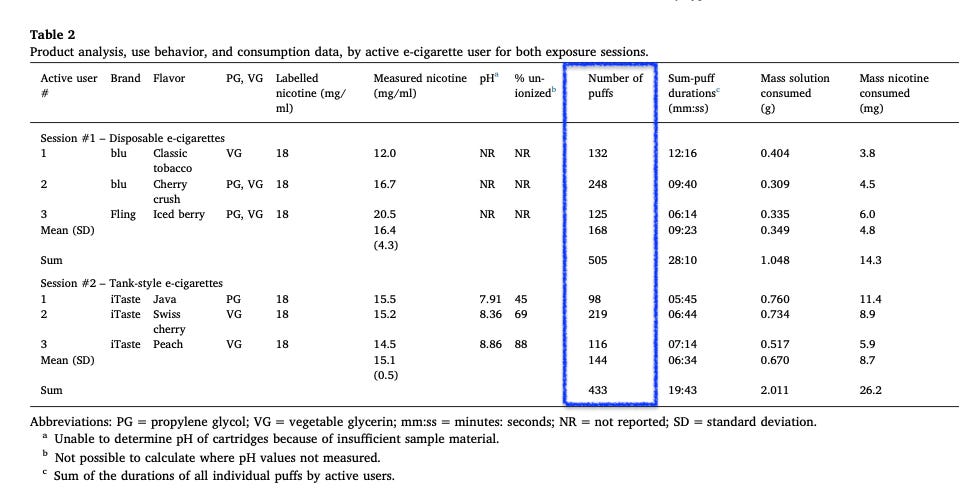
While some users puffed > 200 times in two hours (really an excessive rate), let’s take the mean values 168 and 144 in two hours. This is on average a puff every 42 seconds (session 1) and a puff every 50 seconds (more intense than a puff per minute).
Maelstrom et al are mistaken. This is not a “real life” emission of vaping aerosol in a social event. It is a massive overexposure of bystanders. Observational studies show vapers on average doing 156-338 puffs per day, as shown in this table.
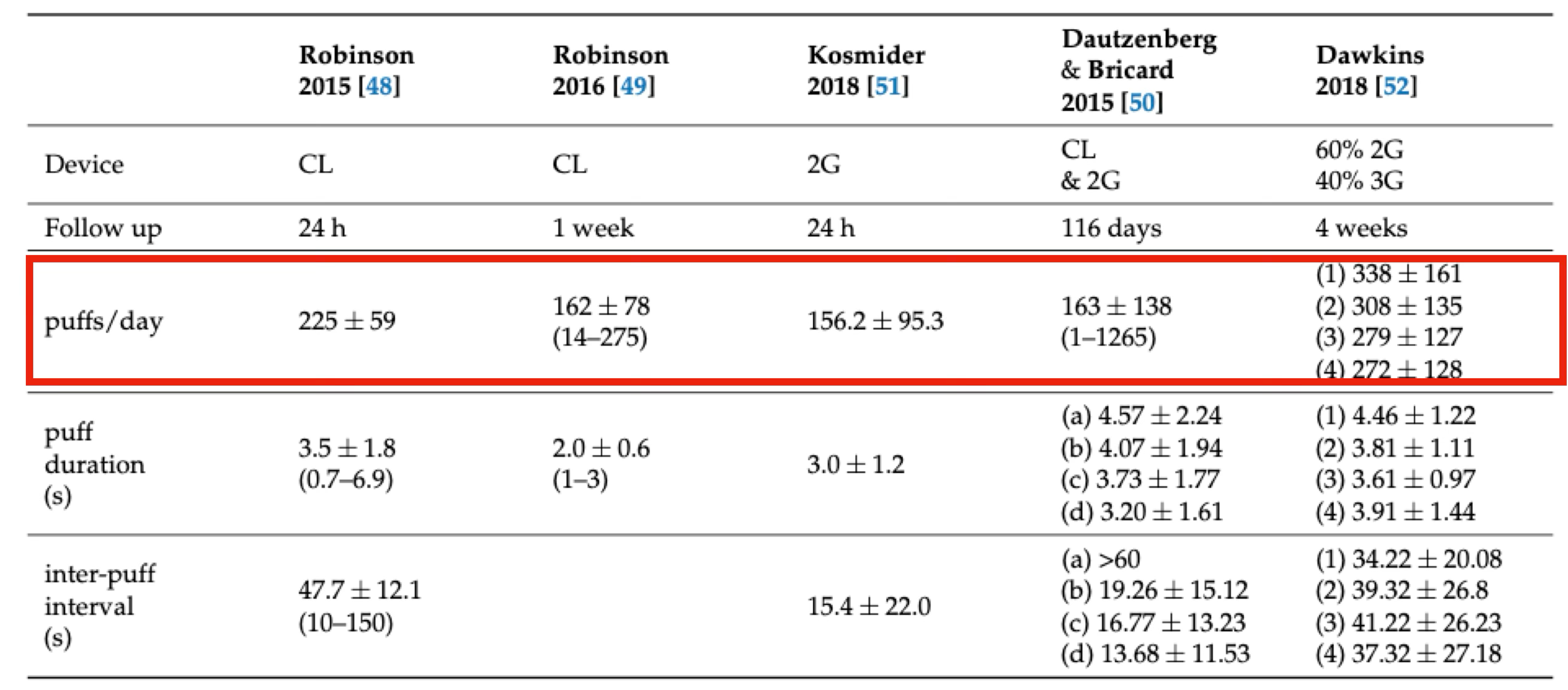
If we take 16 hours of daily wakefulness, this is roughly between 20 and 40 puffs in two hours, meaning a puff every 3-6 minutes (not < 1 minute). Puffing 144 or 168 puffs in two hours might happen sporadically, but it is not representative of a full vaping day, assuming it is “real life” is a gross overstatement. Very few vapers can sustain this intensity for long periods, it would mean puffing 1152 to 1344 times per day.
Now, given the excessive aerosol emission in this study, the levels of cotinine in plasma and saliva that were found (as Chris mentions) are really low: 0.299 ng/ml to 0.326 ng/ml and saliva went from 0.350 ng/ml to 0.395 ng/ml. These values are well below the cut off 3 ng/ml to distinguish smokers and non-smokers and very light occasional exposure to ETS. In fact, these cotinine levels are below non-smokers exposed to open outdoor smoking (1-2 ng/mL).
Aerosol overload in intense and too frequent puffing.
EVA is a very dynamic aerosol varying in time and space, with droplets having high capacity to evaporate. Depending on how the EVA emission was generated, a maximal high UFP level at a given point and position might change rapidly in time if there are favorable conditions for an efficient evaporation.
I criticized in my last Post several studies that measured high UFP levels in EVA generated under unrealistic puffing protocols (as studies inside car cabins) that most of the authors erroneously describe as “normal”. As I show below, conditions producing stable time lasting large numbers of UFPs do not emerge from “normal” usage. Also, the assumption that potential risks increase in proportion to larger UFP numbers rests on very weak evidence.
Besides unrealistic regimented puffing protocols, particle (droplet) counts in EVA are much larger in special conditions in sporadic events, such as visits to vape shops and attendance of vape conventions, where many vapers (up to hundreds) congregate and vape at the same time in the same indoor site. Droplet counts are also abnormally high if puffing is too frequent (as in many chamber studies). What happens when many vapers vape or vape too frequently in the same indoor space? To understand this situation we need some basic physics on the evaporation of liquid mixtures.
Evaporation of liquid mixtures
As EVA is exhaled it is a gas/liquid system, with the liquid contained in the droplets and each compound (PG, VG, nicotine, water) has the capacity to evaporate into the same compound in the gas. What determines how efficiently (say) PG in the droplets evaporates is its saturation ratio R = Pp/Ps, where Pp is the partial pressure (its pressure if it was the only mixture component) and Ps is its saturation pressure (the pressure in which gas and liquid coexist in equilibrium: evaporation compensates condensation).
Evaporation occurs if R = Pp/Ps >1 (supersaturation easier for molecules to escape into the gas). Evaporation is more efficient if R > 1 is larger. Since Ps for each compound decreases when temperature decreases and an evaporating expanding gas cools, then the compound in the droplet for which Ps decreases more rapidly will have larger R and will evaporate more efficiently. PG evaporates more efficiently than VG (in nicotine evaporation depends on its PH, (see Gregory et al).
If only one or a few vapers are exhaling under normal frequency (a puff every 3-10 minutes) expansion, cooling and evaporation proceeds efficiently (more so with PG than VG). If many vapers vape (or vape too frequently) this growth of R stalls: Ps decays more slowly, many new frequent puffs replenish the diluting aerosol with more gas and more droplets, gas cooling slows. Also, the extra airborne droplets coalesce and absorb water, forming larger droplets (coagulation), which are slower to evaporate.
Under ultra-intense puffing conditions (and with low ventilation) the droplets still evaporate into the gas and the aerosol dilutes and disperse, but the decay of UPFs slows down since evaporation is less effective (how much? it depends on the injection rate by the excess of vapers or on the vaping frequency). Efficient ventilation (many air changes per hour) and air mixing favor the cooling of the gas phase, so these factors might invigorate evaporation and reproduce normal low frequency vaping.
The effect of slow decay of particle number concentration (PNC) with excessive puffing can be seen in the comparison of the time sequence of two chamber studies: 5 puffs in 3.5 minutes vs 40 puffs in 20 minutes
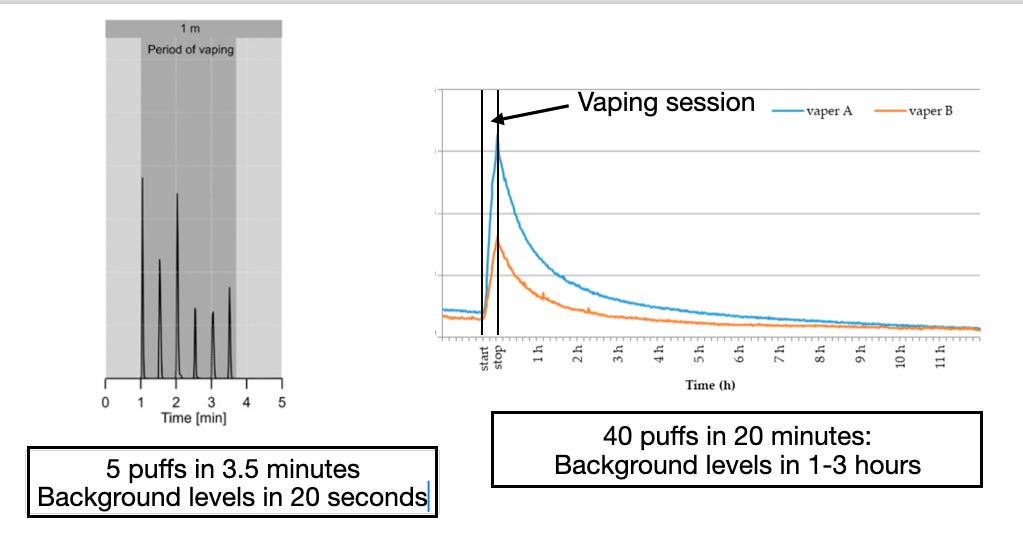
Notice that the rapid PNC decay in 5 puffs in 3.5 minutes is a reasonable approximation to realistic low vaping frequency, while the slow decay of 40 puffs (every 30 s) in 20 minutes in Palmisani et al is consistent with unrealistic frequency conditions: it involves compressing 3-4 hours of average vaping (40 out of 200 puffs per day) into 20 minutes. Vaping tests of Palmisani et al were conducted with natural ventilation, while the results of Martucevicious et al were not affected by ventilation.
However, the conditions that make evaporation less efficient only involve physical changes (phase changes, droplet coagulation, less gas dilution), not change in the aerosol chemistry (reactions): there is more aerosol of the same composition. Therefore, more aerosol mass does not necessarily imply an increase of concerning risks proportional to the increase of mass, though the more mass and longer presence of EVA in an indoor space might cause discomfort and temporary irritation in bystanders (which has been reported in vape shops and conventions).
The simple chemical make up of EVA (even in a large mass from multiple aerosol injections) puts in doubt the claims of “harm hunters” that raise alarms from exposure to large particle numbers. As opposed to ETS or other polluting aerosols for which a larger mass of exposure involves proportionally more risks (because their droplets can also be solid and they and the gas phase all have a complex chemistry).
These arguments provide empiric elements to sustain the relative safety of EVA, with respect to the variety of indoor pollutants to which we are constantly exposed. Even in events that generate a large aerosol mass, EVA lacks sufficiently significant concentrations of reactive compounds (aromatic hydrocarbons, amines, phenols, etc) that can trigger energetic oxidation or photochemical reactions (with nitrogen oxides or ozone), reactions that produce significant amount of nitrosamines and many other toxic or carcinogen byproducts.
A study on vaping conventions
Air concentrations of nicotine, propylene glycol, formaldehyde, acetaldehyde and acroleine were sampled in 4 large scale events (3 vaping conventions and a concert) attended by many vapers in 4 locations in the US in this article
Johnson, J. M., Naeher, L. P., Yu, X., Rathbun, S. L., Muilenburg, J. L., & Wang, J. S. (2018). Air monitoring at large public electronic cigarette events. International Journal of Hygiene and Environmental Health, 221(3), 541-547. Available at
https://doi.org/10.1016/j.ijheh.2018.02.003
Concentrations were compared with control sampling in unoccupied venues and “crowded” controls when used for non-vaping events. Concentrations of formaldehyde were comparable with those of controls, while acetaldehyde was higher in the empty control. In event 4 these aldehydes had higher levels in controls than in the vaping event.
I summarize the data (time weighed average) supplied by the authors in the following table
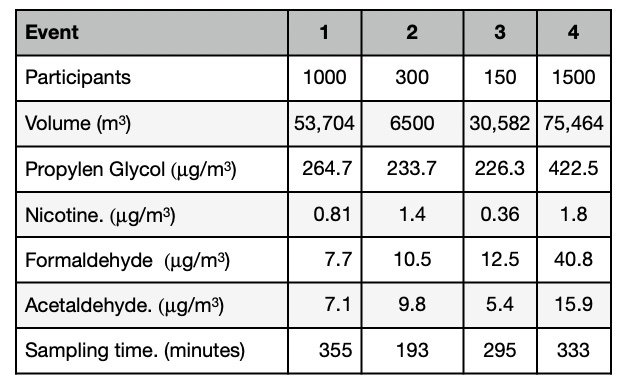
This is essentially a sampling of the gas phase of an aerosol emitted in large volumes with many vaping occupants (it is special because it does not focus on particles and the authors’ narrative is not hostile to vaping).
This data found by the authors is very useful because it is an (unintended) corroboration of the laboratory evidence on the evaporation of the droplets (see Gregory et al). Although users exhale only ~10% of the inhaled PG and base nicotine, the large measured PG and nicotine (assume to be base nicotine) mass densities are consistent with the rapid evaporation of these compounds from the droplets into the large shared gas phase. Also, the fact that concentrations of aldehydes (formaldehyde and acetaldehyde) are comparable to concentrations in non-vaping controls is also consistent with their high retention rates by users.
The authors show that measured concentrations of nicotine, formaldehyde and acetaldehyde are below the safety limits of the US Occupational Safety and Health Administration (OSHA) and US EPA. However, since the authors found no occupational safety limit for PG, they looked for a toxicological reference in the Agency for Toxic Substances and Disease Registry (ATSDR), which sets for PG a very strict safety limit in the Minimal Risk Level of 9 ppb (28 µg/m3) for intermediate 14-365 days exposure, valid for the general population.
Evidently, the PG concentrations of their study 226.3 µg/m3 to 422 µg/m3 are well above this strict threshold, but this is not a valid toxicological comparison because these concentrations correspond to acute exposure in 4-6 hours of vaping, whose appropriate toxicological reference is occupational (vaping events are not meant for the general population, but for adult vapers). The authors recognize this problem and argue that this was the only “number” they could find. However, there are several alternative evaluations of the safety of PG, for example the following two articles:
Cotta, K. I., Stephen, C. D., & Mohammad, N. U. (2017). A review on the safety of inhalation of propylene glycol in e-cigarettes. Global Journal of Pharmacy & Pharmaceutical Sciences, 2(2), 38-46.
”All animal and human studies that analyzed the effect of the inhalation of PG have indicated that, PG does not appear to pose a significant hazard via the inhalation route. In fact, in several of these animal studies the concentrations of PG used were higher compared to the concentration used in e-cigarettes and did not give rise to any toxic effects.”Dalton, P., Soreth, B., Maute, C., Novaleski, C., & Banton, M. (2018). Lack of respiratory and ocular effects following acute propylene glycol exposure in healthy humans. Inhalation Toxicology, 30(3), 124–132.
https://doi.org/10.1080/08958378.2018.1470207
”Ten males and 10 females were exposed to PG aerosol for 4 hrs at 20 and 100 mg/m3 and 30 min at 200 mg/m3. Total PG exposure concentrations (droplets plus gas phase) were 95.6, 442.4 and 871 mg/m3 for the three conditions, respectively. Objective measures of pulmonary function and ocular irritation did not reveal any exposure-related changes. Exposure-related changes in symptom reporting were observed; however, the highest symptom ratings did not exceed “slight” on the scale”
Notice that in the study by Dalton et al cited above 20 adult subjects were exposed during 4 hours to concentrations of 20 mg/m3, 1000 times higher than the concentrations faced by participants of the 4 vaping events. Therefore, there is empiric evidence to dismiss the ultra strict MRL of ATSDR.
Another reference supporting the low inhalation toxicity of PG is the comprehensive toxicological evaluation by the Risk Assessment Committee (RAC) of the European Chemical Agency (ECHA), responding to a proposal to re-classify PG as compound producing organ toxicity, narcotic effects (dizziness, drowsiness) and respiratory tract irritation in a single exposure. The final RAC evaluation appears on top of page 16 in this ECHA document:
“In summary, RAC is of the opinion that the evidence from human studies indicate that single exposure to propane-1,2-diol may induce transient irritation of respiratory and ocular mucosa as indicated by the decreased time of tear film stability or increased frequency of complains related to dryness of eyes and throat. However, these effects do not meet the criteria for classifying propane-1,2-diol as STOT SE, as specified in point 3.8.2.2.1 of CLP Regulation.”
It is very important to be aware and cite these toxicological references that support the safety of PG inhalation (at least in the short-medium time scale). Since practically all PG in the droplets efficiently evaporates into the aerosol gas phase, it is extremely likely that gaseous PG will be the main remnant chemical signature of vaping indoors, including in cases where many vapers vape.
A completely unreliable study on a vaping event.
This is a study on a vaping event that took place in a large hotel hall (4023 m3 volume, 250 m2 area).
Soule, E. K., Maloney, S. F., Spindle, T. R., Rudy, A. K., Hiler, M. M., & Cobb, C. O. (2017). Electronic cigarette use and indoor air quality in a natural setting. Tobacco control, 26(1), 109-112.
The first criticism is that this is not “natural settings”. The event was attended by 59-86 vapers during six collection times (no information on frequency of the full duration of the event) of particle mass density. The baseline was 1.9-3.2 µg/m3, soon the authors measured enormous readings 311.68 μg/m3 (253.44–411.84 μg/m3) to 818.88 μg/m3 (760.64–975.04 μg/m3). The upper end are the highest particle mass densities I have ever seen associated to vaping.
The authors argue that these particle mass densities surpass those of indoor hookah and second hand smoke. Although they do recognize that vaping particulates are not equivalent to those of water pipes and cigarettes, they still invoke risks and recommend prohibition of vaping in all smoke-free public indoor places. Are these huge particle densities reliable? I show below they are completely unreliable.
The problem with this study is the Sidepak AM510, a commercially available portable optically based instrument used to measure particle mass densities. The authors recognize the drawbacks from using this instrument: (1) it cannot detect particles with diameters below 100 nm and (2) Its calibration followed exactly the same parameters previously used in this instrument to sample second hand smoke. These are not minor details, but major shortcomings.
The authors’ explanations are completely erroneous. They argue that by avoiding measuring ultra-fine particles with d < 100 nm their measured mass densities are underestimations (so “real” densities would be even larger). This is completely wrong, since the mass of the particles is overwhelmingly distributed in bigger particles, even if numbers of ultra-fine particles are much larger. However, their worse shortcoming is using the Sidepak AM510 calibrated for smoke particles.
Optically based instruments like that Sidepak AM510 are popular because their portability allows in situ measurements, but only produce reliable particle number/mass densities (with d > 100 nm) when they are well calibrated, meaning conducting tests that compare their readings on simple aerosols with readings from instruments operating with gravimetric methods based on the inertia of the particles (in Impactors), not on light dispersion. These two articles explicitly address the Sidepak AM510
Dacunto, P. J., et al (2013). Real-time particle monitor calibration factors and PM 2.5 emission factors for multiple indoor sources. Environmental Science: Processes & Impacts, 15(8), 1511-1519. https://doi.org/10.1039/C3EM00209H
Jiang, R. T., et al (2011). Determination of response of real-time SidePak AM510 monitor to secondhand smoke, other common indoor aerosols, and outdoor aerosol. Journal of environmental monitoring, 13(6), 1695-1702. https://doi.org/10.1039/C0EM00732C
The statistic analysis of these tests leads to a “correction factor” (CF) with respect to a factory calibration, which for the Sidepak AM510 was made with dust particles (CF = 1). To obtain the right CF for each the target aerosol requires a calibration that considers the properties of the particles: solid/liquid, density, shape, expected numbers, but specially the particles’ optical properties: refractive index, light absorption, etc (since it is an optically based instrument).
The CF = 0.32 for second hand tobacco smoke used by Soule et al was obtained in this form, but it is different from the CFs of other combustion based aerosols (burning wood, cooking, lighting candles). To adapt this instrument for vaping aerosols requires considering that the EVA droplets have different physical and optical properties from particles of aerosols generated by combustion sources. Using the calibration for environmental tobacco smoke renders the study by Soule et al study completely worthless.
An alarmist study on vape shops
The authors from South California of the review mentioned by Chris (Li et al, 2020) published an alarmist study on vape shops. It is very likely that the vape shops that were visited no longer exist or operate under different conditions. Nevertheless, Li et al raise the alarm for finding very high (and sustained) particle numbers in vape shops, much higher than in other businesses in the area (grocery stores, barber shops, pharmacies, etc). However, before sampling particle numbers in nearby shops these authors remarked that
“Because high levels of particles have been reported in restaurants serving barbecued, boiling, and pan-fried food (Lee et al., 2001), these restaurants were excluded in this study.”
This decision shows without doubt the anti-vaping bias in their methodology: they are sampling vape shops in which intense aerosol generating activities occur, so instead of comparing them with grocery stores, they should have compared them with other businesses in which intense aerosol generating activities also occur, such as the restaurants that were excluded. It is easy to show that restaurants produce much more PM and ultra fine particles than vape shops, as shown by these studies:
Wallace, L., & Ott, W. (2011). Personal exposure to ultrafine particles. Journal of exposure science & environmental epidemiology, 21(1), 20-30. Download
Ott, W. R., Wallace, L. A., McAteer, J. M., & Hildemann, L. M. (2017). Fine and ultrafine particle exposures on 73 trips by car to 65 non‐smoking restaurants in the San Francisco Bay Area. Indoor Air, 27(1), 205-217. Download
However, the aim of LI et al is to show harms from vaping, not to understand pollution in its full context, somehow believing that were it not for the vape shops their district would be a pollution free paradise.
These authors even conclude that the pollution from vape shop particles is transported to other neighboring venues and even far outside the local realm, hinting that these huge particle numbers could have an effect on atmospheric pollution. To illustrate how this conception of large scale pollution of EVA is so overstated and misleading, it is useful to remark the fact that an atmospheric projection of PM does occur to a large degree with cooking aerosols (which these authors arbitrarily refused to consider), not with EVA outsourcing vape shops. This study found that cooking makes 35% of atmospheric pollution sources in the metropolitan area of Paris:
Crippa, M., DeCarlo, P. F., Slowik, J. G., Mohr, C., Heringa, M. F., Chirico, R., ... & Baltensperger, U. (2013). Wintertime aerosol chemical composition and source apportionment of the organic fraction in the metropolitan area of Paris. Atmospheric Chemistry and Physics, 13(2), 961-981.
https://doi.org/10.5194/acp-13-961-2013, 2013
Conclusion: How risky is EVA?
To infer the risks of exposure to EVA, we need first to look at vaping primary aerosol (excluding studies with deficient methodology see Post 5 and Post 6). It is made almost entirely of 4 main compounds: PG, VG, nicotine, water, with all other compounds appearing at trace levels as byproducts (mostly aldehydes, see this comprehensive chemical analysis) from low energy heat reactions of the main compounds and of flavor chemicals. Metal oxide nano-particles (see Post 5) and nitrosamines are barely detectable.
EVA is produced from the passage of the low toxicity primary inhaled aerosol through a natural lab (our own respiratory tracts). The evolution of EVA in respiratory tracks does not increase the low toxicity that was inhaled, as it only involves processes of aerosol physics (hygroscopic coagulation, condensation/evaporation, impaction, settling, diffusion, see discussion in Post 8), not chemical reactions generating new compounds.
EVA is also a diluted form of the primary aerosol, since only 10-20% of inhaled aerosol is exhaled, with even smaller share of aldehydes. This diluted aerosol is ejected into a much colder and drier ambient air (thermal reservoir). Since the main compounds have low molecular weight, the gas undergoes a fast adiabatic expansion dominated by kinetic energy (dispersion) to achieve thermal equilibrium with a vast reservoir (outside air).
The process for EVA to reach thermal equilibrium is overwhelmingly controlled by physical processes operating intermittently on a very fast time scale (droplets are airborne only < 1-2 minutes) and in small spatial areas (a few meters around the vaper). EVA evolves at ambient temperature and pressure and has negligible effect on the environment. These conditions do not favor possible oxidation reactions between nicotine (or PG/VG) with ozone or nitrogen oxides.
This almost purely kinetic evolution is in sharp contrast with ETS, cooking aerosols and atmospheric pollution, which stay airborne much longer times and contain much more reactive compounds (volatile and non-volatile) in larger concentrations. These conditions allow for oxidation, hydrolysis and photochemical reactions that produce secondary aerosols (“aging”), reaching thermal equilibrium by reaction balancing. EVA is completely different and much much less toxic.
.