

Dear readers
I dedicate this post and the next one (part 2) to complement and expand the excellent Substack by Chris Snowdon on the weakness of evidence against risks of “passive vaping” (exposure to “second hand” or the aerosol exhaled by vapers).

Chris mentioned several studies on which the EU council is basing its recommendations. I would like to complement Chris’ comments on these studies and add criticism of other studies. The present Substack post (and the one following it) fit very well the series of posts I am currently preparing to criticize the extended literature on this subject published by public health academics
The material I present in this post is accessible and self-contained, but readers looking for more background information and detail should please look at previous posts:
Post 8: Physical and chemical comparison of environmental vape aerosols (EVA) and environmental tobacco smoke (ETS). Difference between exhaled and inhaled aerosols. Temporal and spatial evolution of EVA.
Post 9: Limitations of chamber studies. Two studies comparing vaping and non-vaping atmospheres under the most realistic possible conditions. Indoor vaping under normal household conditions has negligible difference with respect to non-vaping indoor spaces.
Post 10: Discussion on the physical and chemical nature of the ultra-fine “particles” of EVA. Full refutation of the claim (found in most public health studies and health institutions) that emphasize risks from inhaling these particles, by falsely associating them with air pollution or tobacco smoke “particulate matter” (PM).
Post 11. On the global identification of “vapor free” policies. Part 1. How “smoke free” policies evolved from awareness of the risks of active and passive smoking to full “de-normalization” of smoking by enacting smoking bans in large open outdoor areas. Despite lacking evidence on harms from passive vaping, current tobacco control orthodoxy is attempting to extend to vaping the same smoke-free policies implemented on active and passive smoking.
Post 12. On the global identification of “vapor free” policies. Part 2. Dissection of a study in which the authors ignore their own experimental results, issuing alarmist conclusions on risks for children and vulnerable individuals from inhaling ultra-fine particles (UFPs) from indoor vaping. To show how erroneous and misleading these risk assessments are, evidence is presented showing that the authors’ detected UFP levels are well below those found in non-vaping indoor spaces with children occupancy.
The main take home message: Almost all public health studies claim that exposure to environmental vaping aerosols (EVA) is potentially harmful, a claim that is most often justified by suggesting (without proof) an association of the ultra-fine particles (UFPs) of EVA with UFPs and particulate matter (PM) of air pollution and environmental tobacco smoke (ETS). Almost all chamber studies have generated EVA by vaping volunteers following unrealistic puffing protocols, which often lead to artificially high UFPs concentrations. This literature ignores (or plays down) the fact that “particles” in EVA are rapidly evaporating liquid droplets whose mass content is close to 100% made of PG, VG, nicotine and water, while the chemical composition of particles in air pollution and ETS is much more complex and toxic. Also, public health studies look at EVA in isolation, as if it was the only polluting agent in smoke-free indoor spaces, ignoring evidence that indoor dwellers are exposed to multiple other polluting aerosols and gases with higher concentrations and toxicity than EVA.
The weakest of already weak evidence
Then we have the study by Islam et al, a cohort study that associates vaping at home with respiratory symptoms in young folks, but both the exposure to vaping and the symptoms are self reported answers to binary yes/no questions. To analyze studies based on self reported answers it is necessary to control many confounders, since it is difficult to quantify an environmental exposure (harder than counting number of smoked cigarettes), also respiratory symptoms can be caused by many factors, for example aerosols produced by material used to wash walls and surfaces (see review). Without controlling for an appropriate numbers of confounders these associations might be very misleading (this is the same problem with old studies supporting the “gateway to smoking” hypothesis that has been largely debunked).
The “particles” (again)
The major flaw in the public health literature on environmental e-cigarette aerosol (EVA) is the gross misrepresentation of the “particulates” of the exhaled aerosol. These particles are just liquid droplets whose mass is close to 100% made of propylene glycol (PG), glycerol (VG), nicotine and water. I described the physical and chemical properties of these droplets in my Substack (Post 10).
Practically all public health studies on exhaled vapes describe these particulates as a major and important agent of risk and potential harms to bystanders. Behind this description lies the authors’ assumption (which they never prove) of some sort of equivalence between e-cigarette droplets (which technically speaking are “particles”) with “particulate matter” PM of air indoor and outdoor pollution, combustion sources (tobacco smoke) and cooking aerosols, which can be solid or liquid, but are made of a much more complex and toxic chemistry. In the end, the risk alarm on passive vaping is only supported by counting the number of particles and highlighting their very small (“ultra fine”) diameters, which deposition models show they can penetrate deeply in the lungs.
Obviously, studies devoted to measuring and counting particles that (allegedly) can carry potential harm will report large number of particles. However, on top of the common misperception on the nature of the particles, very often the large numbers of particles emerge from chamber studies conducted under unrealistic puffing protocols.
A review of bad studies is a bad review
Chris mentions the review by Li et al. (2020), “a literature review from some California-based researchers. They show their hand early on when they note the rise of vaping in China and other countries and predict that “secondhand exposures to e-cig aerosols will likely become a potential public health problem in those countries soon”. They say that research into the health effects of secondhand vaping is “inconsistent”, but report unusually large readings of PM2.5 in various exceptional or unrealistic settings, such as at a vape conference, in an exposure chamber with a smoking machine and in a lab where the measuring device was positioned 50cm away from the vaper.
This is a good example of a useless review that simply presents an uncritical catalogue of the literature. The authors take at face value many questionable results obtained from unrealistic exposures in chamber studies they reviewed. There is continuous mention of the risk of inhalation of particles (hinting equivalence with air pollution PM), as well as toxins in the aerosol: aldehydes and trace metals. There is reference to studies that found metals, neglecting to report also that they were found in negligible concentrations.
Although the authors mention that vaping particles are liquid droplets with similar composition as the e-liquid, they keep pounding the narrative of particles as vehicles of harm. The review has a section entitled chemical composition of the aerosols, but evidence on the chemical nature of the particles is not discussed nor cited, instead the section offers a confusing mixture of contradictory evidence from primary (inhaled) and environmental (exhaled) aerosols.
Some unrealistic studies
Environmental Vaping aerosol cannot be generated by machines. Chris mentioned the review of Li et al citing a lab study by Czogala et al on environmental vaping that generated the aerosol with a machine. Evidently, this is an unrealistic study, even if the experimental methodology of this study is correct. The reason is simple: a machine generated aerosol is very different from the exhaled one, which passes from a hot and humid environment (respiratory tracts) to a cooler and drier external air. The aerosol exhaled by typical human vapers is much more diluted, since most users retain 80-90% of compounds, including nicotine. Yet, although Czogala et al did not find anything concerning, because it sampled primary aerosol it cannot account for retained compounds, hence their findings represent an overestimation of what they would have found in real exhaled aerosol.
Chris mentions a study by Volesky et al that is much worse than the study by Czogala et al: These authors placed the instruments at 0.5 meters from the vaper’s mouth (like vaping on someones’s face, something real life vapers never do). However, this is not the only flaw of that study:
“Continuous measures of PM2.5 and UFPs were taken for 5.5 min before e-cigarette use, then the user puffed seven times for 6.5 min (exposure), and for 10 min after ceasing e-cigarette use”
A vaper could occasionally puff 7 times in 6.5 minutes (1 puff every 50 s), but this vaping pattern is sporadic and not representative of a full day. Unfortunately, these authors (like many others) are completely ignorant (or oblivious and uninterested) of vaping habits of real users, which are very varied but show also common patterns: no vaper will be vaping 7 puffs in 6 minutes during the whole day.
Even more unrealistic studies: vaping inside cars
The cabin of a car is the ideal small enclosure where an overdose of aerosol could be measured, but normally a vaper in real life cannot vape obsessively while driving a car. There are several studies that have examined exposure to exhaled vape aerosol inside car cabins. All of them rely on volunteers vaping, typically (not always) the copilot in the front seat and instructed to puff in excessively intense regimented form for short periods (car rides of 20-30 minutes). Examples:
Amalia et al (2021), a study in Spain (see my Pub Peer comment on this study). The vaper (a passenger) puffed 84 times in 20 minutes inside a car with windows closed. This vaping pattern is compressing in 20 minutes aerosol from puff numbers normally delivered in 4-5 hours (in average 200 daily puffs). This is evidently a massive aerosol overexposure. The vaper in the same study also puffed excessively in a small office.
Schober et al (2019). A study in Germany tasted vaping and also cigarette smoking and usage of a heated tobacco product (iQOS) in 5 cars. The volunteers selected to vape or smoke as passengers in the front seat were all smokers who received quick instructions on how to vape or use the iQOS just before the tests. They were instructed to puff the three products once every 30 seconds, mentally counting from 1 to 30 between puffs, for a 30 minutes ride. Besides being amateurish, this is an extremely unrealistic puffing rate, since real life vaping is not regimented and typically vapers deliver a puff every 3-10 minutes on average (not every 30 seconds).
The study sampled number and mass particle density as well as volatile compounds (including PG) using very simple portable instruments. The study reports in 1 car particle number density from vaping close to that of smoking, an odd result not reported in any other chamber study. Also, 3 of the 5 cars initial particle levels before the tests comparable with levels during the ride, thus suggesting lack of control of external pollution, a flaw the authors failed to recognize. In general, the study found nothing to be concerned, the e-cigarette and the iQOS emitted orders of magnitude less particles and gases than the cigarette.
The only exception was enormous concentrations of propylene glycol (only in two cars), which the authors reported following a very aggressive panic narrative on the effects of PG on children. However, this effect that can be easily explained: volunteers in those cars were using for the first time in their lives a vape device and were also following a very rigid puffing protocol. Hence they were (most likely) unable to puff the device with a proper inhalation, thus releasing the aerosol without retention with instruments only detecting the very volatile PG in the cabin.
Soule et al (2023) in the US is even a more unrealistic and biased study. The volunteer vapers were also the car drivers, doors and windows were shut but drivers could use the car ventilation system. The protocol was first a “direct bout” of 10 puffs with a 30 s inter-puff interval, with research staff communicating to participants when to take each directed-bout puff using the walkie-talkie. After this bout the driver-vapers were allowed to vape ad libitum for 25 minutes.
It is hard to imagine a more intrusive and contrived experimental protocol: Waiting for a walkie-talkie instruction to vape every 30 s while (at the same time) driving a car. Soule et al justify this protocol for being “similar to procedures used in clinical laboratory studies involving ECIG administration”, ignoring the fact that these clinical protocols are applied to sedentary vapers, not to vapers remotely instructed to puff while driving a car.
The study only measured PM2.5 (droplets below 2.5 micrometers) mass density, which, as expected, rose to very high values (464.48 µg/m3 median peak), but only in the short lapse in which the driver-vapers were subjected to a very unrealistic regimented protocol. However, particle densities sharply decreased once the driving vapers could puff at ease without this constraining protocol. This can be appreciated in Figure 1 of the study
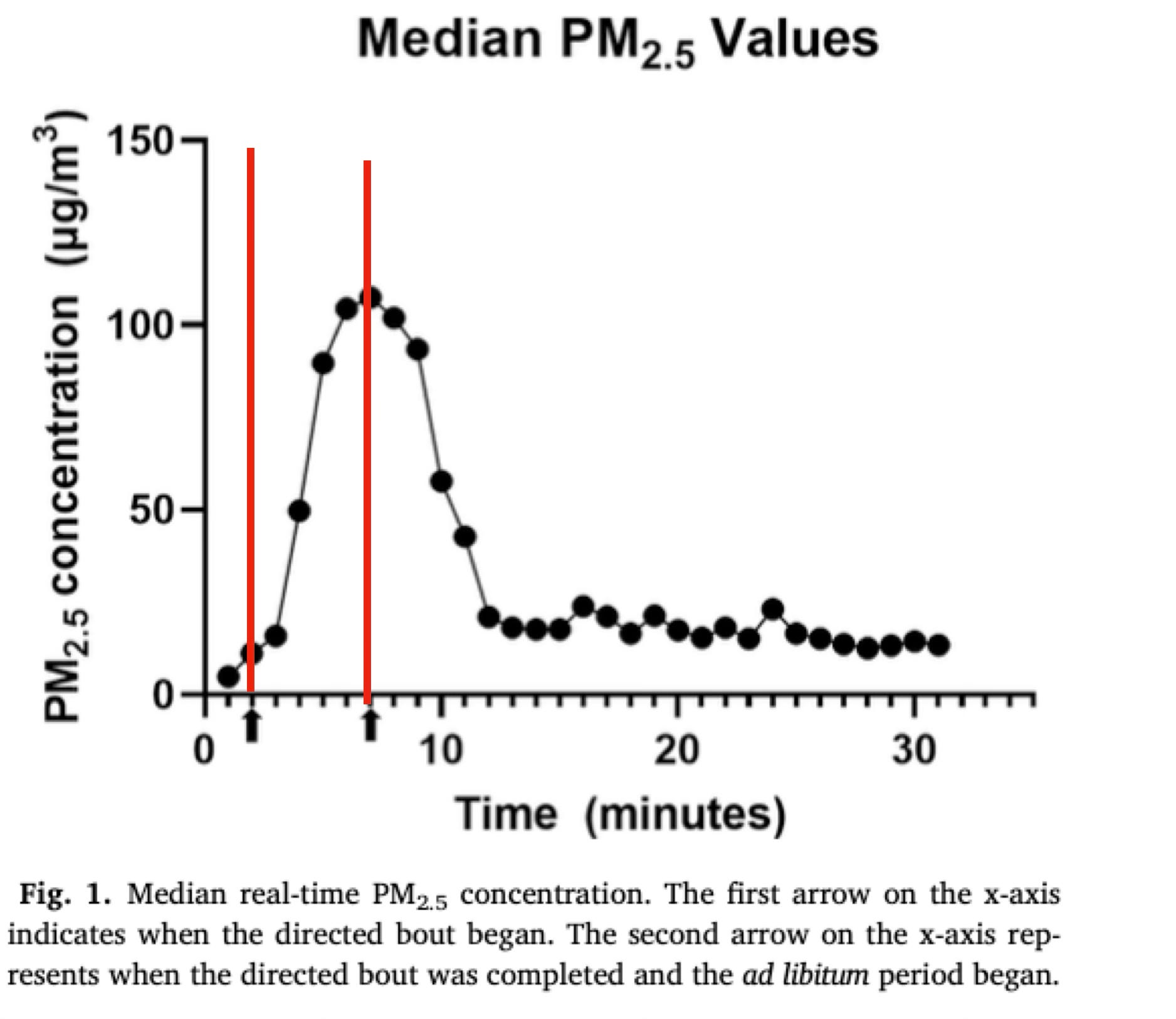
where the short lapse of the 10 puffs protocol is shown between the red lines. Notice how median PM2.5 values are huge only while the vapers are subjected to such uncomfortable puffing protocol, but rapidly decay to low values when they can vape at ease. It is interesting how Soule et al assume their high PM2.5 numbers apply generically to vaping in car cabins, when it is obvious that these readings are simply the effects of an extremely unrealistic protocol that strongly constrains the evaporation of the droplets. Once the driving vapers vape at a normal pace the droplets rapidly evaporate and PM2.5 densities decrease to almost background level.
Despite their claims, Soule et al do not provide evidence of potential harm for vaping under normal puffing conditions inside a car. Nevertheless, they assume that high particle density provides indisputable evidence of potential harm (with emphasis on children). Soule et al argue that high particle density is “highly correlated with the harmful toxicants that are produced from ECIG use”, citing as supporting evidence for this claim a study by Talih et al., 2017 (“Juice monsters”), which examined emissions from devices operated under unusual and extreme power levels, including customized and unregulated mechanical mods (“mech-mods”) operating with user-made coils.
Evidently, the risk assessment of Soule et al is badly mistaken, it is supported by a reference that does not prove their claim of potential harms from their study results. In fact, this reference to “Juice Monsters” is not even applicable to the participants of their study, who used low powered devices.
Vaping in motor vehicles. All car studies (save Schober et al) only measured and counted particles (assumed without proof to be very risky to inhale). Almost all present background material and conclusions in hostile narrative, they all raise alarm on inhalation of ultra-fine particles (emphasizing the exposure of children and vulnerable individuals). In all cases their results have been obtained under utterly unrealistic conditions, not to mention that drivers and passengers in car cabins (including children) where no one is vaping are already exposed to much higher doses of air pollution, with more ultra-fine particles having a much more hazardous chemistry. See evidence on exposure of car occupants to external and internal pollution
Xu, B., Chen, X., & Xiong, J. (2018). Air quality inside motor vehicles’ cabins: a review. Indoor and Built Environment, 27(4), 452-465. Download.
Ott, W. R., Wallace, L. A., McAteer, J. M., & Hildemann, L. M. (2017). Fine and ultrafine particle exposures on 73 trips by car to 65 non‐smoking restaurants in the San Francisco Bay Area. Indoor Air, 27(1), 205-217. Download
Authors ignoring their own results
The study of Borgini et al (dissected in my last Substack and in a Pub Peer comment) is an interesting case, though far from unique. The authors found a good result on the safety of environmental vapes, which is good news for vapers and bystanders surrounding them: the exhaled aerosol from two popular devices (Juul and Just Fog) evaporates and disperses in less than 20 seconds, at 2 meters away and in the direction of the jet the aerosol is almost undetectable. Yet, the authors are not satisfied, this seems to be problematic to their narrative, hence they constructed a harm narrative that runs opposite to their own experimental results. An MD or a regulator reading the conclusions would conclude that exhaled aerosol is potentially toxic to bystanders.
The study by Amalia et al 2023 (reviewed in Post 9: see Comparison of vaping and non-vaping homes) proves that indoor air atmospheres in non-smoking homes shared by a vaper and a non-user spouse are practically indistinguishable from atmospheres in homes where no one vapes. However, the background narrative of the study is very hostile, claiming that vaping “impairs” indoor air quality, a claim questioned by their own results. The authors’ final interpretation is a negative safety evaluations together with an explicit recommendation of harsh anti-vaping interventions in homes were vaping takes place. Specifically, Amalia et al declare in the end that
”Our findings support the importance of comprehensively assessing the consequences of e-cigarette use at home for air quality and bystanders while recommending banning e-cigarette use in the presence of other people.”
This policy suggestion flies in the face of their results, which do not show that indoor vaping produces a worrying degradation of air quality. To request state intervention when potential risks from vaping are barely detectable is an extremely authoritarian attitude that infringes individual liberties and private lives of e-cigarette users.
What is next?
In my next Substack post I will look at other studies mentioned in the Substack post of Chris Snowdon on environmental vaping aerosol (EVA):
A study claiming that exposure to EVA under “normal” social events produces a concerning nicotine overdose in non-vaping bystanders
Studies on vape shops and vaping conventions report exposure to enormous numbers of ultra-fine particles (UFPs), whose inhalation the authors of these studies assume to be potentially harmful and concerning. What really happens when many vapers vape (or vape too frequently) in the same site?
Studies that have found nicotine in walls in vape shops seem to have generated evidence of “third hand” vaping aerosol in parallel to “third hand smoke”.
Stay tuned
.
Dr Roberto Sussman is first and foremost a serious scientist before he is a very committed advocate for tobacco harm reduction. That’s the way it should always be. But with tobacco harm reduction opponents, it’s the other way round: beliefs before evidence or science. The case argued by tobacco harm reduction opponents is riddled with dodgy science which leaves many readers wondering whether the authors’ glaring errors were known or unknown to them. How much and for how long will public health and institutions like the World Health Organisation sustain reputational damage from accepting science with more holes than a colander? The rapid and accelerating replacement of combustible cigarettes by safer, smoke-free nicotine products in the near future is now inevitable and unstoppable. Tobacco harm reduction opponents are soon going to have a lot of egg on their face.